
A practical guide for fintech founders, crypto operators, and compliance professionals navigating the UK regulatory landscape.
The Compliance Stakes Have Never Been Higher
The United Kingdom has established itself as one of the world’s leading fintech hubs. With over 2,500 fintech companies operating across the country and a rapidly expanding crypto sector, the UK financial ecosystem is innovative, competitive — and, by its very nature — exposed to significant financial crime risk.
That exposure is not hypothetical. Money laundering costs the UK economy an estimated approx. £100 billion annually, according to the National Crime Agency. As digital financial services lower the barriers to moving money across borders, regulators have responded with a robust and evolving compliance framework.
For fintech founders, crypto operators, and compliance teams, understanding UK AML regulations is not optional. It is the foundation upon which sustainable, scalable businesses are built.
Understanding UK AML Regulations
UK AML regulations are a set of legal obligations designed to detect, prevent, and report money laundering and terrorist financing. The primary legislative framework comprises the Proceeds of Crime Act 2002 (POCA), the Terrorism Act 2000, and the Money Laundering, Terrorist Financing and Transfer of Funds (Information on the Payer) Regulations 2017 — commonly referred to as the Money Laundering Regulations (MLRs).
The MLRs apply directly to regulated financial businesses, including fintech firms and crypto asset companies. They set out specific obligations around customer verification, risk management, and suspicious activity reporting.
The regulations are not static. The UK has amended the MLRs multiple times since Brexit, diverging in places from EU directives to reflect domestic risk priorities. Staying current with these changes is a compliance challenge in itself.

Key Regulatory Authorities in the UK

Three bodies sit at the heart of the UK’s AML enforcement architecture.
The Financial Conduct Authority (FCA) is the primary supervisor for fintech firms and crypto asset businesses. The FCA enforces the MLRs, conducts supervisory assessments, and has the power to impose significant financial penalties, restrict business activities, or revoke authorization entirely.
For crypto asset firms specifically, the FCA operates a registration regime under the MLRs. Any business providing crypto asset exchange services or custodian wallet services in the UK must be registered before operating. Doing so without registration is a criminal offence.
The National Crime Agency (NCA) receives and analyses Suspicious Activity Reports (SARs) submitted by regulated firms. The NCA’s Financial Intelligence Unit is the central repository for financial intelligence in the UK, and timely, accurate SAR submissions are a legal obligation for any firm that suspects money laundering or terrorist financing.
HM Treasury sets the broader policy direction for the UK’s AML framework. It is responsible for transposing international standards — including those from the Financial Action Task Force (FATF) — into domestic legislation and regularly consults on proposed regulatory changes.
Together, these three bodies create an interlocking oversight system that regulated firms must navigate carefully.
AML Requirements for FinTech & Crypto Firms
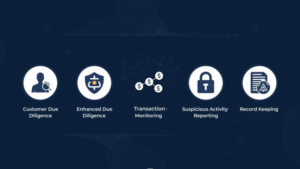
The MLRs impose a series of practical obligations on regulated businesses. For fintech and crypto firms, the core requirements are as follows.
Customer Due Diligence (CDD) requires firms to verify the identity of their customers before establishing a business relationship. This means collecting and confirming names, addresses, and dates of birth at a minimum, and understanding the nature of the intended business relationship.
Enhanced Due Diligence (EDD) applies in higher-risk situations — for example, when dealing with politically exposed persons (PEPs), customers from high-risk jurisdictions, or complex ownership structures. EDD involves deeper investigation and more frequent ongoing review.
Transaction Monitoring is an ongoing obligation. Firms must monitor customer transactions to identify patterns inconsistent with the stated purpose of the business relationship. Unusual volumes, jurisdictions, or counterparties should trigger internal review.
Suspicious Activity Reporting (SAR) is the mechanism by which firms report concerns to the NCA. If a firm knows, suspects, or has reasonable grounds to suspect money laundering or terrorist financing, it has a legal duty to file a SAR. Failure to do so carries criminal liability.
Record Keeping underpins all of the above. Firms must retain CDD documentation, transaction records, and SAR-related information for a minimum of five years.
For crypto firms in particular, robust KYC processes, continuous transaction monitoring, and a clear SAR escalation pathway are non-negotiable components of an effective compliance program.
FCA AML Rules for Crypto Businesses

The FCA’s approach to crypto supervision has intensified significantly in recent years. Under the MLRs, any firm carrying on crypto asset exchange activities or providing custodian wallet services must be registered with the FCA — regardless of where in the world the firm is incorporated.
This means that overseas crypto businesses targeting UK customers are also within scope. The FCA has taken enforcement action against unregistered firms and maintains a public register to help consumers identify compliant operators.
The FCA expects registered crypto firms to demonstrate a credible, risk-based AML framework. This includes having adequate systems and controls, a nominated Money Laundering Reporting Officer (MLRO), and evidence of ongoing compliance oversight. Registration is not a one-time formality — firms must continue to meet the FCA’s standards or risk having their registration revoked.
Why UK AML Compliance Matters for FinTech Companies
Some fintech leaders treat compliance as a cost center. That framing is both commercially and strategically short-sighted.
Regulatory risk is existential. FCA enforcement actions can result in fines, operational restrictions, and reputational damage that no marketing budget can repair. For early-stage companies, a single enforcement notice can end investor conversations before they begin.
Financial crime prevention protects the business itself. Fintech platforms that become conduits for money laundering face not only regulatory consequences but potential criminal liability for senior individuals, including MLROs and directors.
Reputation and investor confidence are linked to compliance maturity. Institutional investors conduct increasingly rigorous due diligence on the compliance posture of fintech businesses before deploying capital. A strong AML framework signals that a business is built to scale.
Banking and partnership access depends on it. Correspondent banks and payment partners conduct their own assessments of fintech and crypto clients. Firms that cannot demonstrate adequate AML controls will find it increasingly difficult to access the banking infrastructure they need to operate.
Common AML Compliance Challenges

Even well-intentioned firms struggle with specific aspects of UK compliance.
Cross-border transactions introduce multiple jurisdictional risk factors. A UK-regulated fintech processing payments to or from high-risk countries must apply heightened scrutiny and document its rationale carefully.
Pseudonymous crypto activity makes beneficial ownership identification difficult. Identifying the real-world individuals behind wallet addresses requires sophisticated tools and investigative processes.
Rapid regulatory change is a structural challenge. The FCA’s approach to crypto supervision is evolving, and HM Treasury consultations on future AML reforms mean that best practice today may be a minimum standard tomorrow.
Technology and monitoring challenges are particularly acute for growing firms. Transaction monitoring systems that work at 10,000 customers often fail at 1,000,000. Scaling compliance infrastructure in line with business growth requires proactive planning.
Best Practices for Achieving UK AML Compliance

Effective compliance is not achieved through documentation alone. It requires genuine embedding across operations and culture.
Implement a risk-based AML framework. The MLRs explicitly require this approach. Conduct a firm-wide risk assessment, segment your customer base by risk level, and calibrate controls proportionately. A one-size-fits-all approach will not satisfy the FCA.
Use blockchain analytics tools. For crypto firms, solutions such as Chainalysis, Elliptic, or TRM Labs allow compliance teams to trace transaction histories, identify wallet risk scores, and flag activity connected to sanctions or illicit sources.
Invest in ongoing compliance monitoring. Compliance is not a point-in-time activity. Customer risk profiles change, regulations evolve, and transaction patterns shift. Regular audits, periodic customer reviews, and continuous transaction monitoring are essential.
Prioritize AML training. Every member of staff who interacts with customers or processes transactions needs to understand their obligations. Annual training, tested and documented, is an FCA expectation — and an MLRO cannot carry the compliance function alone.
Compliance in Practice: Two Illustrative Scenarios
Scenario One: A UK Crypto Exchange

A London-based crypto exchange onboards a new business customer seeking to purchase significant volumes of digital assets. Standard CDD raises a flag — the ultimate beneficial owner is a national of a FATF high-risk jurisdiction. The compliance team applies EDD, requests source of funds documentation, and escalates to the MLRO. The MLRO determines the risk is acceptable with enhanced monitoring in place. The rationale is documented and filed.
Three months later, an unusual withdrawal pattern triggers the transaction monitoring system. The MLRO files a SAR with the NCA and suspends the transaction pending a defense against money laundering (DAML) consent request. The entire process — from flag to resolution — is documented, evidencing a functioning, proportionate compliance program.
Scenario Two: A UK Payments Fintech
A fast-growing payments firm scales its customer base from 50,000 to 500,000 users in 18 months. The compliance team recognizes that its manual transaction review process is no longer sustainable and commissions an automated monitoring solution. The firm also updates its firm-wide risk assessment to reflect new customer demographics and higher-risk corridors identified in the data.
The MLRO presents the updated framework to the board and documents the oversight. When the FCA conducts a supervisory review, the firm can evidence a live, proportionate, and documented compliance program aligned with current UK AML regulations.
Conclusion
UK AML regulations represent one of the most consequential compliance obligations facing fintech and crypto businesses today. The regulatory framework is detailed, the enforcement environment is active, and the cost of non-compliance — financial, operational, and reputational — is substantial.
The firms that succeed in this environment are not those that treat compliance as a box-ticking exercise. They are the ones that build genuine risk management capability, invest in the right tools and people, and treat the FCA’s expectations as a floor rather than a ceiling.
At FinCheck, we work with fintech and crypto firms at every stage of their compliance journey — from initial FCA registration to ongoing program management. Our team brings deep regulatory knowledge and practical experience to help businesses meet their UK compliance obligations with confidence.
Building compliance into your business from the ground up is not just the right thing to do. In today’s regulatory environment, it is the only viable path to sustainable growth.